synonyms: stationary state, steady state approximation, steady state treatment, Bodenstein approximation
https://doi.org/10.1351/goldbook.S05962
- In a kinetic analysis of a complex reaction involving unstable intermediates in lconcentration, the rate of change of each such intermediate is set equal to zero, so that the rate equation can be expressed as a function of the concentrations of chemical species present in macroscopic amounts. For example, assume that $\ce{\textbf{X}}$ is an unstable intermediate in the reaction sequence:
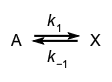 Conservation of mass requires that: \[[\ce{A}] + [\ce{X}] + [\ce{D}] = [\ce{A}]_{0}\] which, since \([\ce{A}]_{0}\) is constant, implies: \[-\frac{{\rm{d}}[\ce{X}]}{{\rm{d}}t} = \frac{{\rm{d}}[\ce{A}]}{{\rm{d}}t} + \frac{{\rm{d}}[\ce{D}]}{{\rm{d}}t}.\] Since \([\ce{X}]\) is negligibly small, the rate of formation of $\ce{\textbf{D}}$ is essentially equal to the rate of disappearance of $\ce{\textbf{A}}$, and the rate of change of \([\ce{X}]\) can be set equal to zero. Applying the steady state approximation (\({\rm{d}}[\ce{X}]/{\rm{d}}t = 0\)) allows the elimination of \([\ce{X}]\) from the kinetic equations, whereupon the rate of reaction is expressed: \[\frac{{\rm{d}}[\ce{D}]}{{\rm{d}}t} = -\frac{{\rm{d}}[\ce{A}]}{{\rm{d}}t} = \frac{k_{1}k_{2}[\ce{A}][\ce{C}]}{k_{-1} + k_{2}[\ce{C}]}\]Note: The steady-state approximation does not imply that \([\ce{X}]\) is even approximately constant, only that its absolute rate of change is very much smaller than that of \([\ce{A}]\) and \([\ce{D}]\). Since according to the reaction scheme \({\rm{d}}[\ce{X}]/{\rm{d}}t = k_{2}[\ce{X}][\ce{C}]\), the assumption that \([\ce{X}]\) is constant would lead, for the case in which $\ce{\textbf{C}}$ is in large excess, to the absurd conclusion that formation of the product $\ce{\textbf{D}}$ will continue at a constant rate even after the reactant $\ce{\textbf{A}}$ has been consumed.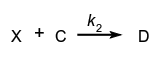
- In a stirred flow reactor a steady state implies a regime so that all concentrations are independent of time.
Note: The steady-state approximation does not imply that \([\ce{X}]\) is even approximately constant, only that its absolute rate of change is very much smaller than that of \([\ce{A}]\) and \([\ce{D}]\). Since according to the reaction scheme \({\rm{d}}[\ce{X}]/{\rm{d}}t = k_{2}[\ce{X}][\ce{C}]\), the assumption that \([\ce{X}]\) is constant would lead, for the case in which C is in large excess, to the absurd conclusion that formation of the product D will continue at a constant rate even after the reactant A has been consumed.
Source:
PAC, 1994, 66, 1077. (Glossary of terms used in physical organic chemistry (IUPAC Recommendations 1994)) on page 1166 [Terms] [Paper]
PAC, 1994, 66, 1077. (Glossary of terms used in physical organic chemistry (IUPAC Recommendations 1994)) on page 1166 [Terms] [Paper]
See also:
PAC, 1993, 65, 2291. (Nomenclature of kinetic methods of analysis (IUPAC Recommendations 1993)) on page 2298 [Terms] [Paper]
PAC, 1996, 68, 149. (A glossary of terms used in chemical kinetics, including reaction dynamics (IUPAC Recommendations 1996)) on page 187 [Terms] [Paper]
PAC, 1990, 62, 2167. (Glossary of atmospheric chemistry terms (Recommendations 1990)) on page 2216 [Terms] [Paper]
PAC, 1993, 65, 2291. (Nomenclature of kinetic methods of analysis (IUPAC Recommendations 1993)) on page 2298 [Terms] [Paper]
PAC, 1996, 68, 149. (A glossary of terms used in chemical kinetics, including reaction dynamics (IUPAC Recommendations 1996)) on page 187 [Terms] [Paper]
PAC, 1990, 62, 2167. (Glossary of atmospheric chemistry terms (Recommendations 1990)) on page 2216 [Terms] [Paper]