https://doi.org/10.1351/goldbook.15267
Polymer composed of macromolecules containing carboxamide groups as linkages in the backbone: \[\ce{-NR-CO\bond{-}}\] where \(\ce{R}\) is hydrogen, alkyl, aryl, or heteroaryl.
Notes:
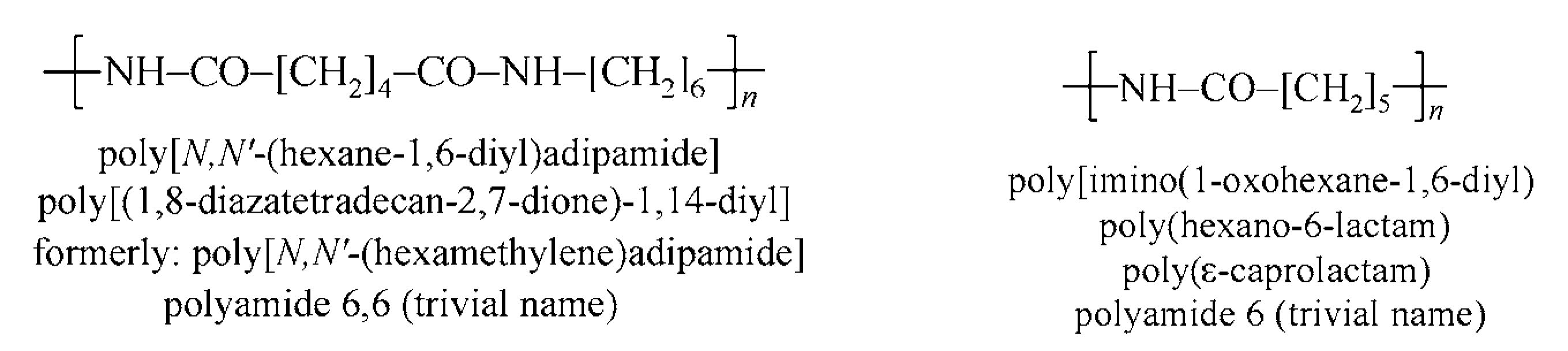
- A polyamide containing, besides \(\ce{-NR-CO\bond{-}}\) linkages, exclusively aliphatic constitutional units is an aliphatic polyamide; examples are: Trivial names of the type: polyamide \(m\) and polyamide \(m,n\) are only used for aliphatic polyamides. Polyamide \(m\) stands for a homopolymeric polyamide derived from an amino acid or a lactam comprising \(m\) carbon atoms; polyamide \(m,n\) stands for a copolymeric polyamide derived from an alkane-1,m-diamine containing \(m\) carbon atoms and an alkanedioic acid containing \(n\) carbon atoms (including those in \(\ce{CO}\) groups).
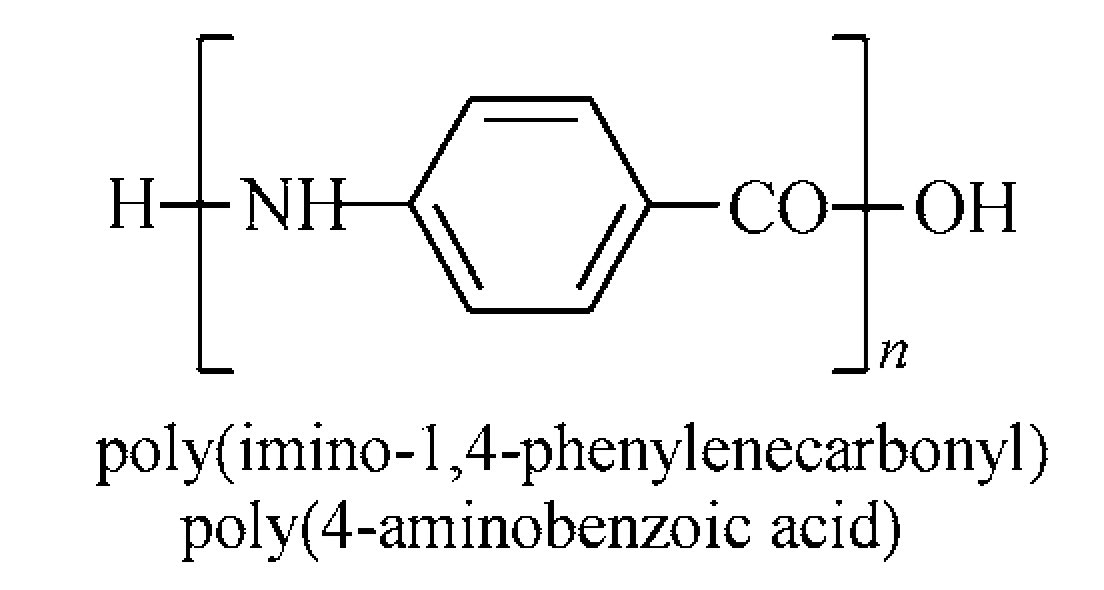
- A polyamide containing, besides \(\ce{-NR-CO\bond{-}}\) linkages, exclusively aromatic constitutional units is an aromatic polyamide commonly referred to as an aramide; example is:
- A polyamide containing pendent carboxy groups is a polyamide acid commonly referred to as a polyamic acid.
- A polymer containing only pendent amide groups is excluded, e.g., polyacrylamide.