A metal-organic framework, abbreviated to MOF, is a coordination network with organic ligands containing potential voids.
Note: This wording accounts for the fact that many systems are dynamic, and changes in structure and thus corresponding changes in potential porosity or solvent and/or guest filled voids may occur depending on temperature, pressure, or other external stimuli. For these reasons it is also not required that an MOF be crystalline. Arguments based on both theory and experiment can be used, suggesting that some of these coordination polymers (i.e., those that can be described as salts) with direct anion-cation binding are more prone to form structures with open frameworks exhibiting permanent porosity than those forming positively charged networks. However, the grey zone between these extremes is large and increasing so that a definition based on such a charge distinction would be too restrictive.
Example: An early example of a compound not initially considered as being an MOF is shown in Fig. 1 and presented without acetonitrile, acetone solvent, and anions. In Fig. 2 two archetypal MOFs are shown: MOF-5 (left) and HKUST-1 (right).
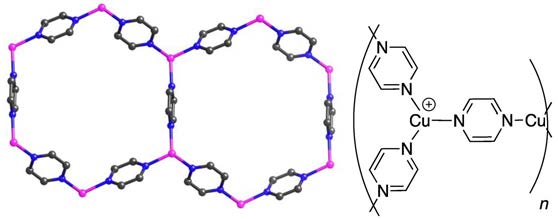
Figure 1: Example of a coordination network that can be seen both as a 2D-coordination polymer and as an MOF. Coordinated acetonitrile, acetone solvent, anions ($\ce{PF6}$), and hydrogen atoms are not shown. Mauve: $\ce{Cu}$; blue: $\ce{N}$; grey: $\ce{C}$.
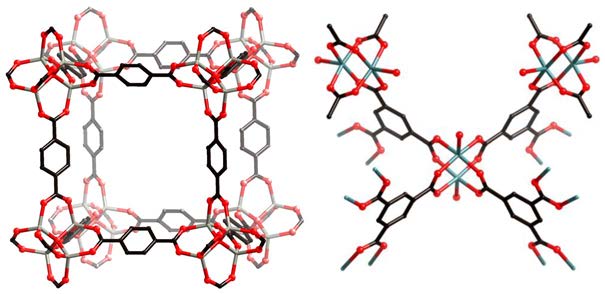
Figure 2: Archetypical MOFs: Left: The zinc and carboxylate-based MOF-5 from the group of Yaghi where each [$\ce{Zn4O}$] unit is bridged by six benzene-1,4-dicarboxylates. Right: HKUST-1 with copper(II) paddlewheel dimers bridged by benzene-1,3,5-tricarboxylates. Hydrogen atoms are not shown. A line drawing is not included for these compounds as the parenthesis and "$n$" convention, as used in previous cases, showing the propagation of the polymer is not workable for these compounds. Light grey: $\ce{Zn}$]; turquoise: $\ce{Cu}$]; grey: $\ce{C}$]; red: $\ce{O}$].
Source: PAC, 2013,
85, 1715. (
Terminology of metal–organic frameworks and coordination polymers (IUPAC Recommendations 2013)) on page 1719 [
Terms] [
Paper]