https://doi.org/10.1351/goldbook.12822
A coordination compound with repeating coordination entities extending in 1, 2, or 3 dimensions.
Note: Coordination polymers do not need to be crystalline; therefore, the more appropriate terms (for crystalline states) 1-periodic, 2-periodic, and 3-periodic cannot be used throughout. These compounds may in some cases, such as those being composed of mainly carboxylates, even be regarded as salts. The prefix 1D-, 2D-, or 3D- is acceptable for the indicating the degree of extension of the coordination polymer.
Example: A classical type of single-chain coordination polymer is the (4,4'-bipyridine-N,N)-bridged cobalt(II) compound depicted in the figure below. Names of this and other example compounds are left out of the main text, as new IUPAC recommendations are being prepared for these materials. 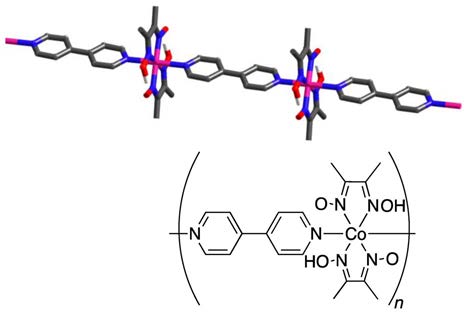
An example of a 1D-coordination polymer. Hydrogen atoms on carbon have been left out for clarity.
Mauve: $\ce{Co}$; blue: $\ce{N}$; red: $\ce{O}$; grey: $\ce{C}$; white: $\ce{H}$.