https://doi.org/10.1351/goldbook.09147
Voltammetry in which a square-wave potential waveform is superimposed on an underlying linearlyhyphen‐varying potential ramp or staircase ramp. The current is sampled just before the end of the forward-going pulse and of the backward-going pulse and the difference of the two sampled currents is plotted versus the applied potential of the potential or staircase ramp. The square-wave voltammogram is peak-shaped. See figure.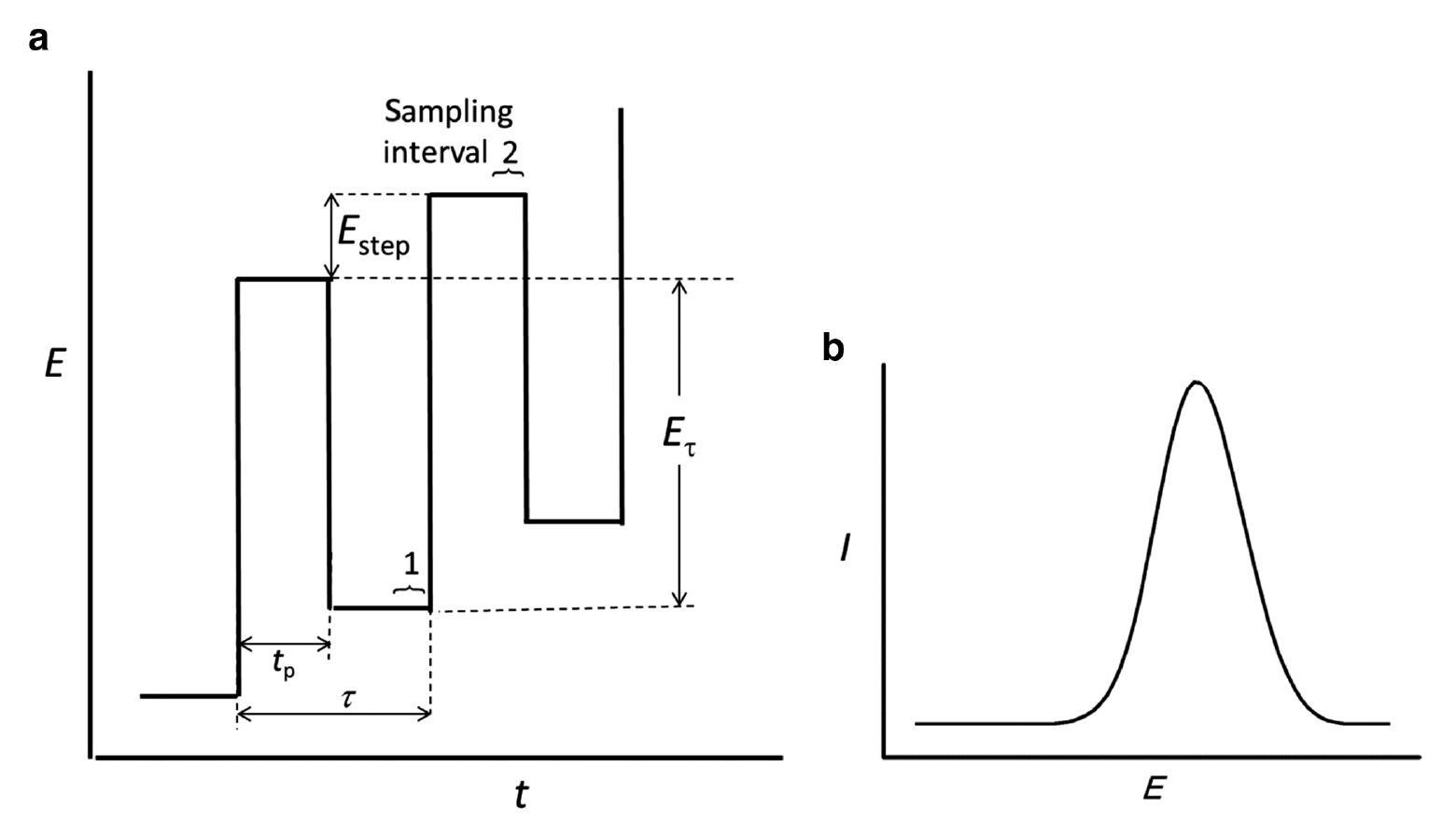
(a) Waveform for square wave voltammetry (not to scale). Typical values for pulse parameters are \(\tau = \pu{10 ms}\), \(t_{\rm{p}} = \pu{5 ms}\), \(E_{\rm{\tau}} = \pu{25 mV}\), \(E_{\rm{step}} = \pu{4 mV}\). Sampling interval indicated by horizontal curly brackets is typically \(\pu{1 ms}\). (b) Square wave voltammogram of the difference between currents sampled at ‘2’ and ‘1’ against applied potential.
Notes:
- The sensitivity of SWV depends on the reversibility of the electrode reaction of the analyte.
- Most instruments show plots of the current at the end of the forward-going pulse and of the backward-going pulse vs. the potential, as well as their difference. This can give valuable information on the kinetics of the electrode reaction and the electrode process.